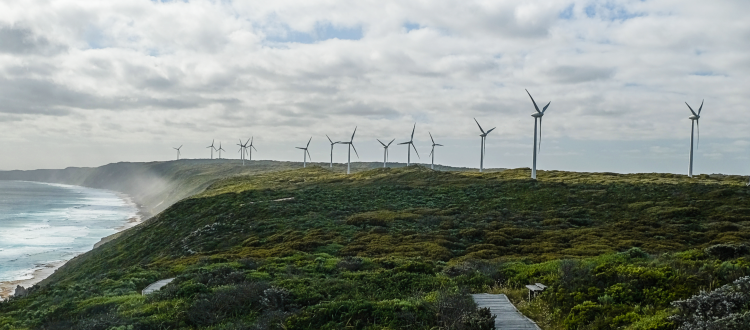
The Great Southern region Western Australia stretches from inland farming areas like Narrogin and Katanning to coastal towns such as Albany, Denmark and Esperance. While the region shares some common climate features, conditions vary between inland and coastal areas and the west and the South Coast.
Most of the Great Southern has a Mediterranean-style climate, with hot, dry summers and cool, wetter winters. Along the South Coast, summers are usually milder, but the weather can change quickly, with strong winds, cold fronts, and heavy rain events, especially in winter.
Since the 1970s, the region has become hotter in summer and drier in winter. Each decade, the hottest summer temperatures have increased, while winter rainfall has decreased, especially in the western areas. Places like Albany and Narrogin have already seen about a 15% drop in rainfall since the 1960s.
Along the South Coast, the climate changes more from year to year. There are still some very wet winter days and even the occasional summer storm. Although rainfall is decreasing in some areas, it is happening more slowly than on the west coast. In Esperance, the average yearly rainfall has dropped slightly since the 1970s and has become more variable from year to year. More dry periods between wet years, mean that our water supplies become less reliable and harder to manage.
This trend is expected to continue into the future. Most climate models show that winter rainfall will decrease, with longer dry periods but heavier rainfall during storms when they do occur. Temperatures are also projected to keep rising, leading to hotter average days and more extreme heat.
Reduced rainfall reliability and increased temperatures driven by climate change as well as growing demand are placing pressure on existing surface and groundwater sources that supply water to the Great Southern region.
Reduced rainfall reliability and increased temperatures driven by climate change as well as growing demand are placing pressure on existing surface and groundwater sources that supply drinking water to the Great Southern region.
By 2050, Albany could get over 20% less rain each year whilst in Esperance the projections show a continued slower decline but enhanced variability between very wet and very dry years. This increase in rainfall unreliability will significantly impact recharge in our groundwater sources and streamflow in our surface water sources.
Work to ensure the long-term security and sustainability of drinking water in Western Australia's Lower Great Southern is gathering pace, with planning underway for the region's next major water sources.
Great Southern water supply
Steady population growth in coastal towns, the impact of climate change and improving resource recovery are driving our plans for the Great Southern.
The region has a number of local independent town water supply schemes. There are also 2 integrated networks – the Lower Great Southern Towns Water Supply Scheme (LGSTWSS), which supplies Albany, Mount Barker, Kendenup and nearby areas. The main source of water for the LGSTWSS is the Albany bore field.
The Great Southern Towns Water Supply Scheme (GSTWSS) supplies 44 towns in the region. Stirling dam and Harris dam are water sources for the GSTWSS.
Our plans to secure drinking water supplies
To help secure drinking water for the Lower Great Southern region, we've been working on new strategies. In 2021, Denmark was connected to LGSTWSS, so it no longer relies only on surface water from Quickup Dam and Denmark River. We're also exploring new sources like groundwater and seawater desalination. Right now, 43% of the region’s water comes from groundwater and 57% from surface water (primarily Harris Dam and Stirling Dam). These changes help make sure towns have a more reliable and balanced water supply.
As part of our investigations into seawater desalination for the LGSTWSS, we’re conducting environmental and Aboriginal Heritage surveys, site assessments and marine investigations. Learn more about this project.
We’re equipping new bores in Esperance and have started investigating new long term source options. Learn more about this project.
We’ve also implemented alternative non-drinking water supplies for local community use. This includes irrigating public open spaces to help reduce the demand on high quality drinking water supplies.
Increasing water efficiency and water recycling
We’re committed to recycling as much of the Great Southern’s wastewater as possible. Over 70% of our wastewater flows for beneficial community re-use across the region. There is 100% re-use in Albany, Boddington, Kulin, Mt Barker, Tambellup, Walpole and Williams. The region’s recycling is contributing towards our statewide target of 35% by 2035.
In Albany, around 2,290 million litres of treated wastewater is used to irrigate an Albany tree farm each year. Over a million trees on the farm captures some 70,000 tonnes of carbon from the environment!
We can all help
Remember every drop of water counts and it can all add up to big savings. Find out what you can do to save water starting today.
Responding to climate change
Low rainfall coupled with ongoing hot and dry conditions have impacted on-farm storages, shire dams and Department of Water and Environmental Regulation strategic community water supplies. To secure water supplies in these areas we utilise water carting when needed and shire fixed standpipes.
Find out more